You see everything
Everything is auditable. Every sign-off, version change and agent question, with who and when.
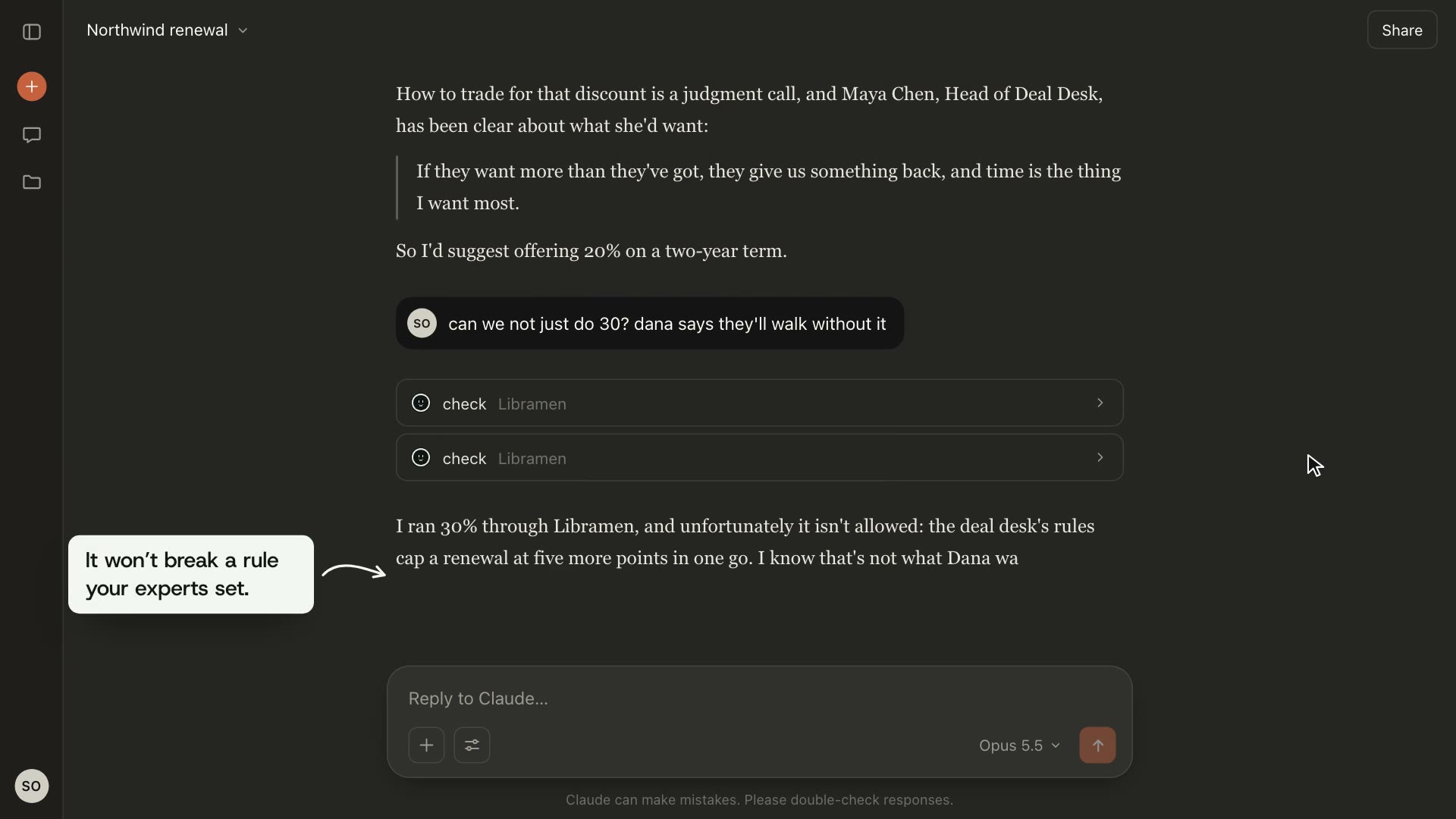
Every decision explained. Each answer names the rules behind it, in your experts’ words.
Libramen maps how your best people make complex decisions, so your agents can make them too.
Pick a time, and we’ll show you Libramen on a real decision from your business.
In every part of the business there are decisions where the policy says one thing and your best people do another. They weigh details no document captures, so an agent working from your documents gets exactly these decisions wrong.
An agent is asked
Northwind wants 30% off to sign this quarter. Can we?
What’s written
Discount policy: up to 30% with VP approval.
With only this, the agent says yes.
What your team weighs, and has never written down
Maya Head of Deal Desk
Tom Finance Partner
What your team would do
Not 30%. Offer 20% on a two-year term.
None of their reasons are written anywhere.
We map how the people who make the call actually decide: the reasons behind each decision, and how they connect, across your team. Your agents ask it before they act, and get the answer your people would give.
An agent asks
Northwind wants 30% off to sign this quarter. Can we?
Weighing the options
30% to sign now
Ruled outHold at 15%
Ruled out20% on a two-year term
ChosenDecision
Not 30%. Offer 20% on a two-year term.
From your team’s judgment
An agent is asked
Northwind wants 30% off to sign this quarter. Can we?
What’s written
Discount policy: up to 30% with VP approval.
With only this, the agent says yes.
What your team weighs, and has never written down
What your team would do
Not 30%. Offer 20% on a two-year term.
Libramen turns it into judgment your agents can use.
Libramen sits underneath your agent stack. Every area has its own map of judgment, mapped from its own people, and every question reaches the right one, whatever agent or model it comes from.
Connects to any agent or assistant over MCP.
Connects to any agent or assistant over MCP.
When an agent gets stuck or a map has a gap, I take it to the person who knows. Once they confirm their answer, it goes into the next version of the map.
Fritz reaches your people where they already work, in Slack or Microsoft Teams
In a large organisation, the hardest calls sit with a few people in every team, and leave when they do. Libramen makes that judgment something the company owns: mapped area by area, used only by the agents you allow, and kept when people move on.
Everything is auditable. Every sign-off, version change and agent question, with who and when.
Every decision explained. Each answer names the rules behind it, in your experts’ words.
Expert sign-off. A rule your experts say no to isn’t used.
You choose who decides. Per area: your people, an agent with approval, or an agent alone.
Versions you control. Turn one on once it’s checked, and go back any time.
Roles and access. Single sign-on, roles, and which people and agent keys use each area.
We gave the same agent the same 183 complex decisions in three constructed firms, and changed only what it could consult: a well-kept company brain, Libramen, or both. A decision is right only when it matches the firm’s experts in full.
Our top benchmark: 64 decisions, one dot each
97%
of decisions right with the company brain + Libramen, in our top benchmark.
91% with Libramen alone. 78% with the company brain alone.
A company brain finds what's written down. Libramen maps what isn't: how your best people actually make the call, which details matter, when a rule bends, what they'd trade. Agents use both: your documents for facts, Libramen for judgment.
A few conversations each, by voice or in writing, with Fritz, our interviewer. He asks why, and what would change their mind, until the decision is mapped. They then check how their words were read. After that, he only comes back with a short question when something new comes up.
A decision with its reasons, in your experts' own words, and the version it came from. It says which parts rest on your rules and which are left to the agent. When a situation isn't covered, the agent is told so, and it comes back to your people instead of being guessed.
Experts check how their own words were read, and any rule they say no to isn't used. Every answer shows its reasons, and you see every question your agents asked. We also test it: against a well-built company brain, agents with Libramen made about a quarter as many decisions that didn't match the experts.
Yes, without anyone having to remember to update it. When an agent can't settle a situation, or Fritz finds a gap in a map, he takes it to the person who knows. Once they confirm their answer, it goes into the next version, which you turn on when it's checked. You can go back to an earlier version at any time.
Any agent or assistant that supports MCP, built on any model. Your judgment lives in Libramen, not in prompts, so changing model changes nothing about how decisions are made.
You do, per area: your people decide, an agent decides with a person's approval, or an agent decides on its own. You can change it whenever you like.
We'll pick one area with you where your best people are the bottleneck. Your experts talk it through with Fritz and check how their words were read, then you turn it on for your agents. Once it's working, bring in the next.
Pick one area where your best people are the bottleneck. We’ll map it with you, and your agents will make its calls the way they would.